

Friday Dispatch: Maybe This Is What It Means to Stand at Sinai
This one has footnotes


Friday greetings,
This may be a lot to begin with, especially without any context. I hope you’ll pour some coffee or tea (or water or whatever) and stay with me, as this may be a longer-than-usual Dispatch.
Five quotes have touched me this week.
Rabbi Sandra Lawson:
“Revelation is the possibility that truth can still emerge in a diverse and fractured community. It is the possibility that we can remain connected to one another even when we do not hear everything the same way.”1
Yossi Klein Halevi:
"And part of our confusion, part of our inability to respond coherently, is that we're emotionally overwhelmed between outrage and shame. Or maybe it's more accurate to say that one of the Jewish people has taken on the responsibility of shame, and another part of the Jewish people has taken on the responsibility of protective outrage. And we need a coherent Jewish voice that's morally coherent, that can speak with contempt to the Nicholas Kristofs of the world, on the one hand. But we can also look at ourselves and say, you know, ashamnu bagadnu, we're guilty, we've betrayed our own most basic moral standards. And it's really hard to hold those two positions simultaneously."2
Rabbi Jeff Salkin:
“Chutzpah is a way of standing: standing up, standing for, standing with, and standing out.”3
Rabbi David Ingber:
“The prophetic calling demands we challenge power wherever it abuses the vulnerable. It also demands that we defend our own people when they face existential threats. Too many progressive Jews have abandoned the second imperative, with catastrophic consequences.”4
Haviv Rettig Gur:
“I'm sick of it all. I know you're all sick of it too.”5
Nu?
So much of my experience since October 7 has been about recognizing extremes, around and at times within me. Much of my engagement with current Jewish thinking about Israel, about antisemitism, and about Jewish life comes through a steady stream of articles, opinion pieces, podcasts, and analyses.
I read and read, listen and listen, react, respond, metabolize, nod my head, shake my head, notice my reactions, look for my own confirmation bias, observe where I am stuck in trauma, and generally just allow myself to have whatever experience I am having.
This might sound kind of vague or unremarkable.
But the last part signals a degree of growth, namely, because I am no longer in a constant argument with myself. That’s not to say I have anything “figured out,” more that I have released the need to figure anything out. It’s an absurd notion that such a thing could even be possible.
At the same time, I have stepped away from the kinds of discussions and debates I engaged in, largely via social media. There has been relief in that, relief that reflects the privileges of living in a leafy suburb, working from home, and working outside of institutional constraints or demands.
Nuance remains my north star. So does Torah.
What I mean by that is that returning to Jewish study, prayer, learning, and connection has proven to be the strongest anchor (boy, I’m writing a lot about anchors lately) in a time when pretty much everything I took for granted about the world and my place in it has been upended, undone, reshaped, challenged, or downright dismantled.
A beloved Jewish elder told me yesterday about the importance of “grounding,” as in literally walking barefoot in the grass (or sand or dirt). It is very easy to get so caught up in thinking (and putting more and more things into the thinking mix by way of aforementioned material) that I forget where I’m actually standing.
Teaching an Omer Learning Circle has been one way of grounding myself Jewishly. Saying yes to being a guest services leader/substitute, another. Having lunch with a Jewish friend. Wearing Jewish symbols publicly and proudly. Connecting with friends in Israel about politics, war, and antisemitism, yes, and also about what books we’re reading, what we’re writing, and the sights and sounds of where we are in a literal sense – a cat sunning in Haifa, a Tel Aviv bike path commute, a café in Modi’in while the kids are in school, my backyard listening to the birds.
For me, these are the spiritual equivalent of placing my bare feet on the ground.
What I always seem to come back to is love. Maybe that’s why the above quotes spoke to me so clearly and in such different ways. Each one of these teachers said or wrote something this week that my soul received like a sliver, a splinter, of revelation.
Some validated me, which is always a welcome feeling. Some challenged me, which I might resist a bit, yet also pushed me, lest I become the very thing I abhor.
And some do something a bit harder to describe. They offer me a little more terra firma. They say, here, here is language for something you are witnessing and experiencing: Excessive shame. Protective outrage. Polarization. Exhaustion.
Suddenly, the word “cleave” leaps to mind.
The term is infamous for being a "contronym"—a word that means two opposite things. While it means "to split apart," it can also mean "to stick or cling tightly to" (e.g., "to cleave to your beliefs").6
This word strikes me as a lightning rod for two simultaneous, if seemingly opposing, fears.
I am afraid of the Jewish people cleaving, i.e., splitting apart.
I am also afraid of the Jewish people cleaving, i.e., clinging so tightly we forget how to see, how to hear.
The space between these is where I find myself just about constantly.
And this brings us to Sinai.
Shavuot is the holiday when the Israelites stood together at Mt. Sinai after a 49-day journey through the desert, and received the Ten Commandments.
One of the things that happened there?
.וְכָל־הָעָם רֹאִים אֶת־הַקּוֹלֹת וְאֶת־הַלַּפִּידִם וְאֵת קוֹל הַשֹּׁפָר
And all the people saw the sounds ...7
Rabbi Chanan Morrison explains the power of synesthesia8 and how it fosters an experience of unity, of oneness:
“If we are bound and limited to the present, if we can only perceive the universe through the viewpoint of the temporal and the material, then we will always be aware of the divide between sight and sound. The prophetic vision at Mount Sinai, however, granted the people a unique perspective, as if they were standing near the source of Creation. From that vantage point, they were able to witness the underlying unity of the universe. They were able to see sounds and hear sights. God’s revelation at Sinai was registered by all their senses simultaneously, as a single, undivided perception.”9
Maybe synesthesia is the antidote to cleaving.
Maybe, if only for one mighty moment, we can remember that unity is not the same as conformity.
Maybe, if only for a breath, we can return to an ability to see sounds and hear sights, to perceive what is beyond the confines of our habitual ways of relating.
And maybe – this I direct at myself – I can yield an iota of my own righteousness for long enough to look my fellow Jew in the eyes and say hello, even if I feel angry and threatened by their beliefs.
So, I have to admit, I am a bit surprised to be writing these words.
A defiant part of me doesn’t WANT to give an inch, not a freaking millimeter, to those I relate to as wrong.
There, I said it. I’m not proud, but it’s true.
And yet, I have to believe and trust that some wise inclination is revealing itself here – whether I want to receive it or not.
Maybe this is what it means to stand at Sinai.
It’s not about receiving what we want to hear.
It’s about hearing what’s happening because that’s what’s happening.
It’s about seeing what’s booming above and around us and within our own small, fragile chests teeming with a cosmic cocktail of ego and awe.
It’s about being fully present and being counted among a people ready to become a nation.
On Shavuot, we read the Book of Ruth. I’ll close with this beautiful reflection from Mijal Bitton:
“Like Ruth, we don’t get to see the full arc of what we are building. But Ruth tells us it matters anyway. In a moment when we Jews are exhausted and unsure of what comes next, Ruth reminds us that civilization is rebuilt not only through politics and power, but through extraordinary acts of covenantal loyalty between ordinary people.”10
If you’ve made it through this whole post, thank you for reading. Thank you for standing with me. The world is quaking. And so is the truth that each of us has the power to help create and build a future beyond brokenness.
Chag sameach, Shabbat Shalom, and love,
Jena
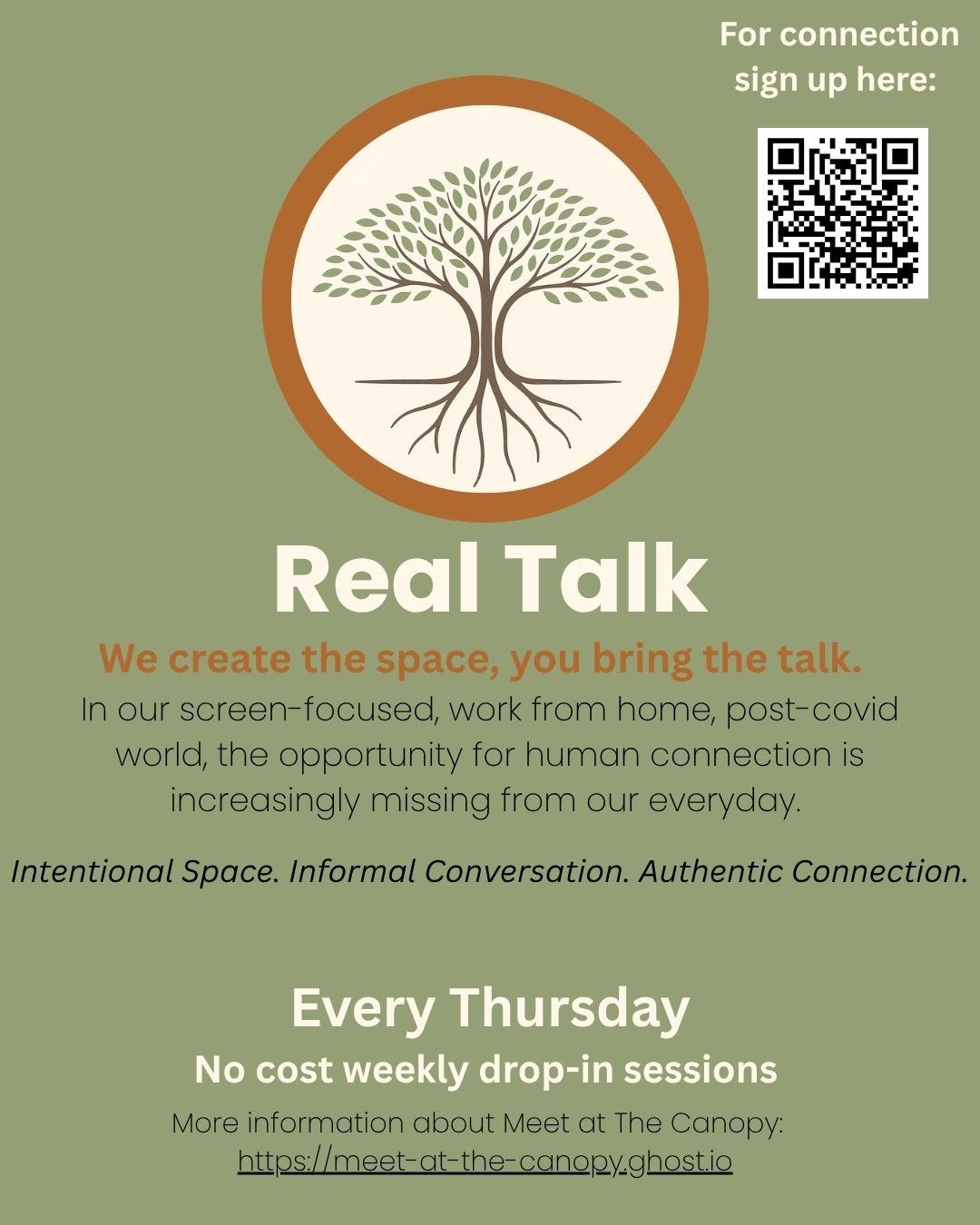
I’m very happy to pass along a wonderful opportunity from The Canopy, a group of three women (including my dear friend Jill) who are seeking and creating “a sense of belonging, shared learning, and real connection” during a time of accelerating disconnection. Check out Real Talk here!

Donniel Hartman and Yossi Klein Halevi, “Why We’re Losing the War Over Israel’s Legitimacy,” For Heaven’s Sake, Episode 236, May 20, 2026

Rabbi David Ingber, “Progressive Rabbis’ Blind Spot,” Tablet Magazine, May 17, 2026


“Shavuot: Seeing Sound,” Rav Kook Torah

Thank you for sharing so honestly, as always ❤️
A profoundly true statement.